The nineteenth century was also a time of great domestic change for Denmark. A liberal constitution, which took effect June 5, 1849, brought to an end centuries of absolute monarchy. Danes could now form political parties, elect representatives to a parliament, and were guaranteed freedom of religion, assembly, and speech. The country also under-went an economic revolution. Danish farmers found it difficult to compete with the low-priced grains offered in European markets by American and Russian exports and increasingly turned to dairy and pork production. The growth of industry attracted many job-hungry Danes to developing urban centers. But agricultural change and the rise of industrialism were not enough to stop rising discontent and eventually one out of every ten Danes felt compelled to emigrate; most traveled to the United States. (Source)

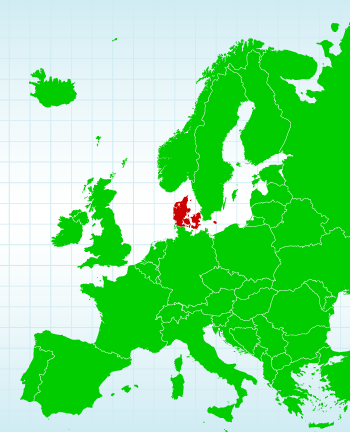
(Map)
Immigrants - Land was at a premium in Denmark. The early Danish immigrants found Wisconsin to be a welcoming place with an abundance of land. Danish immigrant Laurits Jacob Fribert declared Wisconsin a haven for impoverished Scandinavians in search of land in his Haandbog for Emigranter til Amerikas Vest (Manual for Emigrants to the American West). Fribert left a promising career as a lawyer in his homeland to become a farmer in Waukesha County.
Though the number of Danes immigrating to Wisconsin was modest overall, never reaching more than about one percent of the state's population, in 1870 the state boasted the largest number of Danes in the country. Though they settled far and wide across the state, the highest concentrations of Danes were in Waukesha, Racine, Winnebago, and Brown Counties. (Source)
Only 2,000 Danes immigrated from 1820-1850. During that period, it was costly to travel. Teachers, preachers and tradesmen were mostly the individuals who could afford to travel.
Many Danes were impressed by letters they received from friends and relatives, who had immigrated to America. They decided to immigrate themselves. Now and then, an immigrant would travel alone and send for his wife and children at a later date. The Danish Pioneer's editor Sophus Neble did just that, coming to America alone and sending for his girlfriend and his brothers at a later date.
Unemployment and tough times in Denmark, especially for farmers, persuaded many to take the big step and immigrate.
Many Baptists and Mormons left Denmark from 1850-1870 and settled in America. Some settled in Utah, others in Arizona and Wisconsin.
Approximately 20,000 Danes left Denmark between 1870 and 1895. Steamships left Denmark and arrived in America 10 days later. Scandinavian-American Line was owned by Danes. The ship, Frederik VIII, transported more than half a million immigrants to America. In addition, more and more women immigrated. The states preferred by the Danish immigrants were Nebraska, Iowa, Kansas, North and South Dakota, Minnesota, Michigan and California.
The Danish immigrants were hardworking individuals and were very much in demand and respected. During that period, it was difficult for the immigrants to settle in America. A simple house built with logs was often the first home for immigrants from all nations. Many farmers settled in Wisconsin, Minnesota and Iowa.
During the period 1895-1910, Danish immigrants settled in various cities in America, such as New York City, Chicago and Racine, Wisconsin. Many workers, especially tradesmen, settled in cities. Tradesmen were dreaming of establishing their own businesses and thus becoming independent. Danes enjoyed building churches, which resembled churches in their homeland. Danes also celebrated various events, which had ties to their homeland. (Source)
Traditions, Customs, and Beliefs - Danes have a variety of traditions and customs that have been adapted or preserved in Danish American society. Everyday life customs include men and women shaking hands with everyone when entering or leaving a group. Danes and Danish Americans take great pleasure in setting a proper table and following a proper etiquette. This often means using fine Danish porcelain from one of the two famous Danish porcelain makers, Royal Copenhagen or Bing and Grøndahl. Being a guest requires that one bring flowers for the hostess. When a guest meets the host or hostess shortly after being entertained, the proper greeting is Tak for sidst ("tuck for seest")—Thanks for the last time.
Entertaining and tradition merge in the many customs surrounding Christmas. Because of the dark Scandinavian winter nights, Christmas, with its message of hope, light, and love, is especially welcomed and celebrated in Denmark. Danish Christmas customs are also celebrated by Danish Americans. December begins with baking. No home is without at least seven different kinds of Christmas cookies. These treats are shared with guests, and it is customary to take decorated plates of cookies to friends and relatives. This custom is the origin of the well known porcelain Danish Christmas plates that can be found in many homes.
The celebration of Christmas culminates on Christmas Eve, a holiday traditionally shared with close family. Usually the family attends church in the late afternoon and then returns to a feast of roast goose and all the trimmings. A special dessert is prepared: "risengr ø d" (reesingroidth), a rice pudding in which one whole almond is placed. The person who discovers the almond will have good luck throughout the coming year. After dinner, the family sees the decorated Christmas tree for the first time. It is lit with candles and decorated with paper cuttings of angels, woven straw ornaments, heart-shaped baskets, and strings of Danish flags. In Danish American homes, the tree is decorated earlier and lit with electric lights. The family joins hands and dances around the tree, singing favorite carols. Gifts are exchanged, and the family enjoys coffee and cookies. To assure happiness and good fortune, before the family goes to bed it is important to take a bowl of porridge to the nisse ("nisa")—the mythical little people of Denmark who inhabit the lofts and attics of homes. (Source)
Sources
http://www.everyculture.com/multi/Bu-Dr/Danish-Americans.html
http://www.wisconsinhistory.org/highlights/archives/2005/06/new_book_celebr.asp
http://www.spartacus.schoolnet.co.uk/USAEdenmark.html
http://www.thedanishpioneer.com/english/moving.html
http://www.loc.gov/rr/genealogy/bib_guid/danishamer.html
http://www.visitdenmark.se/usa/en-us/menu/turist/inspiration/detkulturelledanmark/heritage/danish-immigration.htm?wbc_purpose=bas


No comments:
Post a Comment